How to Choose the Right Stair Lift for Your Home
Stairs can become a significant barrier to independence when mobility becomes more difficult. Whether the challenge is caused by age, reduced mobility, an injury, or a disability, a stair lift can provide a safe and practical way to move between floors without having to relocate or make major structural changes to the home.
However, choosing the right stair lift is not simply a matter of selecting a model. The staircase itself, the user's mobility needs, available space, weight capacity, safety features and long-term requirements should all be considered.
This guide explains the most important factors to consider when choosing a stair lift.
1. Start with the staircase
The first question is simple: What type of staircase do you have?
Most stair lifts fall into two main categories:
Straight stair lifts
A straight stair lift is designed for a staircase that runs in a single, uninterrupted direction without curves or intermediate landings.
They are generally simpler to install and are an effective solution when the staircase has a straightforward layout.
Curved stair lifts
If the staircase has a bend, curve, spiral section or landing, a curved stair lift may be required. The rail is individually designed to follow the shape of the staircase, allowing the user to travel continuously between floors.
In some homes with multiple straight sections, it may also be possible to use two straight stair lifts, although this requires the user to transfer between them. The best solution depends on the staircase and the individual's mobility.
The staircase should always be professionally assessed before choosing a model.

2. Consider the user's mobility needs
The best stair lift is the one that the user can operate comfortably and safely.
Consider questions such as:
Can the user safely sit down and stand up independently?
Do they have difficulty bending their knees or hips?
Can they maintain a stable sitting position?
Can they use a standard seat comfortably?
Would a powered swivel seat make getting on and off easier?
Do they need additional support?
Is the stair lift intended for occasional or everyday use?
A person who can walk with a cane may have very different requirements from someone who uses a wheelchair or has significantly reduced mobility.
The user's current needs and likely future needs should both be considered. Choosing a stair lift based only on today's mobility can mean that the equipment becomes unsuitable as the user's needs change.
3. Check the weight capacity
Every stair lift has a specified maximum user weight.
When selecting a model, make sure the user's weight is comfortably within the manufacturer's stated capacity. Do not choose a model simply because it is the least expensive option.
For users who require a higher weight capacity, specialist heavy-duty models may be available.
It is also important to consider the dimensions of the seat and the user's overall comfort—not just the maximum weight.
4. Look carefully at the seat
The seat is one of the parts of the stair lift the user interacts with every day.
Depending on the model, features may include:
Padded seating
Adjustable armrests
Seat belts or safety restraints
Swivel seats
Powered swivel mechanisms
Adjustable seat heights
Foldable seats and footrests
A swivel seat can be particularly useful for people who find it difficult to turn while standing on the stairs. It allows the user to rotate toward the landing before standing up, helping make transfers easier.
The correct seat height is also important. The user should be able to sit comfortably and get on and off the stair lift without unnecessary strain.
5. Don't overlook stair width
Available space is another important consideration.
A stair lift occupies part of the staircase, so it is important to make sure there is sufficient space for the stair lift and for other people who may need to use the stairs.
Foldable seats, armrests and footrests can help reduce the amount of space occupied when the stair lift is not being used.
A professional assessment should take into account not only the width of the stairs but also doorways, landings, radiators, windows and other obstacles around the staircase.

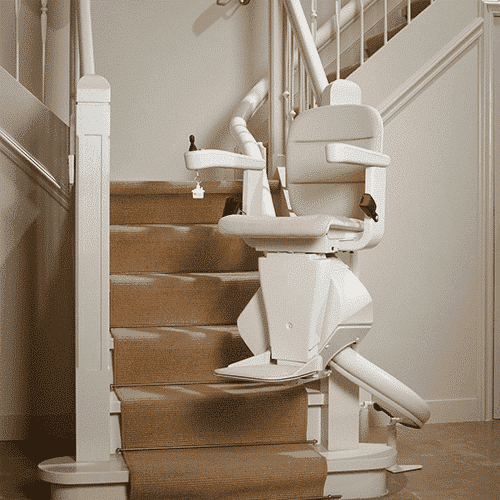
Handicare Simplicity PLUS line
6. Prioritise safety features
Safety should be one of the most important factors when comparing stair lifts.
Depending on the model, useful safety features can include:
Safety belts
Swivel seats with locking mechanisms
Obstacle sensors
Safety sensors on the footrest
Smooth acceleration and braking
Emergency stop controls
Battery backup
Diagnostic systems
Secure armrests and footrests
Battery-powered stair lifts can continue operating for a limited number of journeys during a power interruption, depending on the model and battery condition.
Rather than choosing a stair lift based on the number of features it has, consider which features are genuinely useful for the person who will use it.
7. Think about where the stair lift starts and finishes
The position of the stair lift at the top and bottom of the stairs is extremely important.
The user needs enough space to safely get on and off the chair. In some situations, the rail can extend beyond the first or last step to create a safer parking position.
For example, a user may need to exit the stair lift onto a hallway rather than directly onto the first step.
This is one reason why stair lift selection should involve an assessment of the entire staircase and surrounding areas rather than simply measuring the length of the stairs.
8. Indoor or outdoor use?
If the staircase is outside the home, a standard indoor stair lift may not be appropriate.
Outdoor stair lifts need to be designed to withstand environmental conditions such as:
Rain
Humidity
Sun exposure
Temperature changes
Dust and debris
If you are considering a stair lift for an external staircase, make sure the selected system is specifically designed and rated for outdoor use.

9. Consider installation and after-sales support
A stair lift is not simply a product delivered to your home. Installation, servicing and technical support are part of the overall solution.
Before purchasing, ask:
Who will install the stair lift?
Is installation included?
Is the rail custom-made for the staircase?
What warranty is provided?
Is regular servicing available?
Who should you contact if there is a technical problem?
Are replacement parts available?
What happens if the stair lift stops working?
For a mobility product that may be essential to someone's ability to access different floors of their home, reliable after-sales support can be just as important as the initial purchase price.
10. Don't choose based on price alone
Price is naturally an important consideration, but the cheapest stair lift is not necessarily the best value.
The total cost can be influenced by factors such as:
Straight or curved staircase
Length and complexity of the rail
Number of floors
Seat configuration
Weight capacity
Additional safety features
Installation requirements
Warranty and servicing
Curved stair lifts generally require more individualised manufacturing because the rail must follow the specific geometry of the staircase.
When comparing quotations, make sure you are comparing complete solutions, rather than simply comparing the price of the equipment.
11. Get a professional assessment
One of the most important steps when choosing a stair lift is having the staircase assessed by an experienced specialist.
A proper assessment should consider:
The staircase — shape, width, length, landings and obstacles.
The user — mobility, weight, height, posture and ability to transfer.
The home — where the user needs to enter and exit the stair lift and how the staircase is used by others.
The future — whether the solution is likely to remain suitable as the user's mobility changes.
A professional assessment can help determine whether a straight, curved or another configuration is most appropriate.
Choosing a stair lift: a simple checklist
Before making a decision, consider:
Staircase: Is it straight, curved or multi-level?
User: What are the person's current mobility needs?
Capacity: Is the weight capacity sufficient?
Seat: Is it comfortable and easy to use?
Safety: Does it have the features the user needs?
Space: Will other people still be able to use the stairs?
Access: Can the user safely get on and off at both ends?
Installation: Is professional installation included?
Support: Is servicing and technical assistance available?
Future needs: Will the stair lift remain appropriate if mobility changes?
The right stair lift can restore independence
A stair lift can do much more than make stairs easier to navigate. For many people, it can make the difference between being restricted to one floor and being able to continue using their entire home independently.
The right choice depends on the person, the staircase and the home. There is no universal stair lift that is ideal for everyone.
At Abletools, we can help you assess your staircase and identify a stair lift solution suited to your mobility requirements and home environment.
If you are considering a stair lift, contact Abletools to discuss your requirements and arrange an assessment.